
Airway Treatment and Sleep Apnea Care in Palatka, FL
You wake up tired even after a full night’s sleep. Your partner says you snore. Your jaw is sore in the morning, or you keep cracking teeth and wearing down fillings. Most people assume these are separate problems.
Sometimes they’re connected, and the connection is your airway.
At Island Dentists, we look at more than your teeth. The size and shape of your tongue, the wear on your teeth, and how your jaw sits can all be early clues that your airway is struggling during sleep. That’s why airway treatment is part of what we offer, and here’s what it actually looks like.
What Is Airway Treatment?
Airway treatment at our office means oral appliance therapy: a custom-made device, similar to a mouthguard, that you wear while you sleep. It gently holds your lower jaw slightly forward, which helps keep your airway open so you can breathe more easily through the night.
It’s used for adults with obstructive sleep apnea (OSA), and for adults who snore. There’s no mask, hose, or machine, just a small device made to fit your mouth.
What We Look For
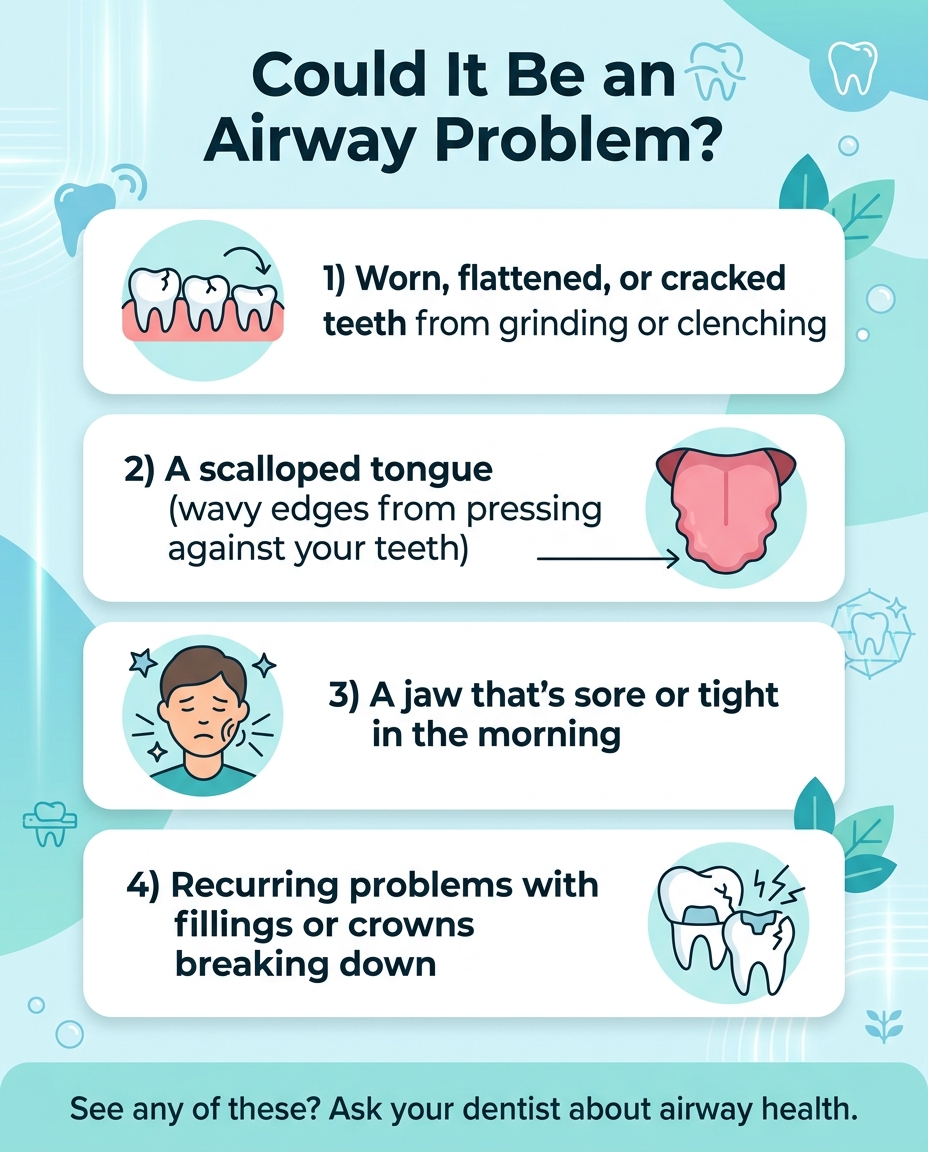
During a routine visit, we may see things that can be signs of an airway problem, such as:
- Worn, flattened, or cracked teeth from grinding or clenching
- A scalloped tongue (wavy edges from pressing against your teeth)
- A jaw that’s sore or tight in the morning
- Recurring problems with fillings or crowns breaking down
None of these prove you have sleep apnea. They’re reasons to take a closer look at your airway health. If you also snore, wake up unrefreshed, or have been told you stop breathing in your sleep, it’s worth a conversation.
What Happens If You Wait
Sleep apnea doesn’t usually get better on its own. Untreated, it has been linked to high blood pressure and heart problems, on top of the daytime exhaustion and worn-down teeth. Getting it evaluated and treated can mean less snoring, better rest, and real support for your overall health.
What Happens First: A Diagnosis From Your Physician
We want to be upfront about this part. Sleep apnea has to be diagnosed by a physician, usually through a sleep study. Dentists can spot warning signs and treat with an oral appliance, but we don’t diagnose sleep apnea ourselves. National guidelines say the same, and they also call for teamwork between your physician and your dentist.
If we notice signs, we’ll talk with you about them and help you take the next step, which is usually a conversation with your doctor about a sleep study.
What Treatment Looks Like at Island Dentists
Once you have a diagnosis and your physician has recommended an oral appliance:
- We talk through your history and goals. What’s your sleep like, what have you tried, and what do you want to change?
- Your appliance is custom-made. It’s built to fit your teeth and bite, not pulled off a shelf.
- We fit and adjust it. Small adjustments help the device work well and stay comfortable.
- We follow up. Guidelines call for periodic check-ins with both your dentist and your sleep physician, so you’re never left on your own.
Oral Appliance vs. CPAP
CPAP, the mask-and-machine treatment, is still generally the first choice for moderate to severe sleep apnea. Oral appliances are recommended for adults who can’t tolerate CPAP or would rather use something else, and they can work well for mild sleep apnea. Many people find an appliance easier to wear night after night, which matters, because the best treatment is the one you actually use.
Your physician will help decide which option fits your situation.
Frequently Asked Questions
Can a dentist treat sleep apnea?
A dentist can provide oral appliance therapy once a physician has diagnosed sleep apnea and recommended it. Diagnosis itself comes from your doctor.
Is an oral appliance as effective as CPAP?
For mild sleep apnea, they can perform similarly. For moderate to severe sleep apnea, CPAP generally reduces breathing interruptions more. Across the studies reviewed by the American Academy of Sleep Medicine, oral appliances reduced breathing interruptions meaningfully, with about half of patients seeing at least a 50% drop. Results vary from person to person.
Do I need a sleep study first?
If you’re being treated for sleep apnea, yes. Snoring should be evaluated by a physician too, since it can be a sign of sleep apnea. If you’re not sure where you stand, come talk to us and we’ll help you figure out the right next step.
What if my sleep apnea is severe?
CPAP is usually the first-line treatment for severe cases. An oral appliance may still play a role, for example if you can’t tolerate CPAP. Your physician will guide that decision.
Will my insurance cover it?
Coverage depends on your plan, and oral appliances for sleep apnea are often handled through medical rather than dental insurance. Call our office and we’ll help you sort out what applies to you.
I grind my teeth but haven’t been diagnosed with anything. Can you help?
Yes. Grinding and airway problems can be related, and we can look at what’s going on, protect your teeth, and point you toward a sleep evaluation if the signs suggest one.
Ready to Talk About It?
If you snore, wake up exhausted, or keep wearing down your teeth, come see us. We’d rather help you sort it out early.
📍 1023 St Johns Ave (next door to Island Doctors), Palatka, FL
📞 (386) 385-3700
🕘 Monday–Friday, 9 AM–4 PM, and every other Saturday, 8 AM–1 PM
We accept most dental insurance plans and Medicare Advantage, and offer financing through CareCredit and Cherry. New patients are always welcome.
Sources
- Ramar K, et al. Clinical Practice Guideline for the Treatment of Obstructive Sleep Apnea and Snoring with Oral Appliance Therapy: An Update for 2015. J Clin Sleep Med. 2015;11(7):773–827. PMC
- AASM/AADSM joint guideline press release. aasm.org
- Cleveland Clinic, Scalloped Tongue. clevelandclinic.org