
A tooth comes out. Maybe it was pulled during an extraction, maybe it finally gave up after years of a cracked filling, maybe it got knocked loose some other way. Either way, there’s a gap now — and once the soreness fades, it’s tempting to just leave it. It’s not hurting anymore, so it doesn’t feel urgent.
If you’re not sure yet whether a tooth can still be saved or needs to come out in the first place, that’s a separate question — we break down how we make that call in this post on extractions vs. root canals.
But an empty space where a tooth used to be isn’t just a cosmetic issue waiting to happen. It changes how your bite works, how your jawbone holds up, and how your other teeth sit — often faster than people expect. The good news is you have real options, and figuring out which one fits you isn’t complicated once you know what each one actually does.
What each option actually does
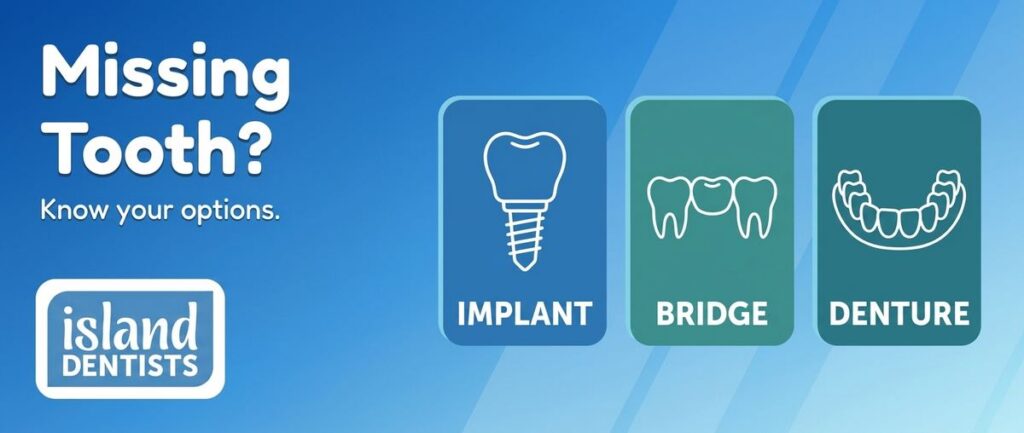
A dental implant replaces the whole tooth, root and all. A small titanium post is placed into the jawbone, and once it heals in place, a crown is attached on top. Because the post takes over the job the natural tooth root used to do, it’s the option that comes closest to acting like a real tooth — including keeping the jawbone underneath it active and healthy.
A bridge replaces a missing tooth without surgery. It’s a fixed appliance anchored to the healthy teeth on either side of the gap, with a replacement tooth suspended in between. It doesn’t involve the jawbone at all — it relies on your existing teeth for support.
Dentures and partials are removable. A full denture replaces an entire arch of teeth (upper, lower, or both); a partial denture fills in several missing teeth while clipping onto the teeth you still have. Both come out for cleaning and sleep.
What happens if you wait
The jawbone under a missing tooth needs the pressure of chewing and a tooth root in place to stay strong — without that stimulation, it starts to shrink. That process is gradual, but it doesn’t stop on its own. At the same time, neighboring teeth tend to drift toward the open space, and the tooth that used to bite against the gap can start to shift too, since it no longer has anything to meet in the middle. Over months, that adds up to a changed bite, and a changed bite is harder — and often pricier — to fix than the original gap would have been.
How the decision gets made
There’s no single “best” option — the right one depends on your mouth, your timeline, and what you want day to day. A few things we walk through at your exam:
Five factors
How much bone is there. Implants need enough jawbone to anchor into. If there’s been significant bone loss already, that doesn’t rule out an implant, but it may mean a bone graft first.
How many teeth are missing. A single missing tooth opens up all three options. Several missing teeth in a row often points toward a bridge or a partial; a full arch usually means a denture or an implant-supported denture.
How fast you need a result. A denture or a bridge can often be finished in a matter of weeks. An implant is a longer process by design — the post needs time to heal into the bone before the final crown goes on.
Budget and insurance coverage. Costs and what insurance covers vary by option and by plan — we go over the real numbers for your situation at consultation rather than guessing here.
How much day-to-day upkeep you want. Implants and bridges are fixed in place and cared for like natural teeth. Dentures and partials come out for cleaning and need to be relined or adjusted over time as your mouth changes.
Dental implants: the most permanent option
Implants are usually the first thing we discuss for a single missing tooth or a few scattered ones, because they don’t rely on the neighboring teeth for support and they keep the jawbone stimulated the way a natural root does. The tradeoff is time — placement, healing, and the final restoration typically happen in stages, not in one visit. Not everyone is a candidate right away; bone density, smoking, and a history of gum disease all factor in, and we’re upfront if a graft or another option makes more sense for you. Full detail on the process is on our Dental Implants page.
Bridges: a fixed option without surgery
A bridge is a solid choice when the teeth on either side of the gap are healthy enough to support it and you want something fixed rather than removable, without the longer implant timeline. It usually takes two visits — one to prepare the supporting teeth and fit a temporary, and a second to place the final bridge once it’s ready. More on that process is on our Crowns & Bridges page.
Dentures and partials: full or partial replacement
When several teeth are missing, or an entire arch, dentures and partials are often the most practical path — and today’s versions fit and look better than the dentures a lot of patients remember their parents wearing. For patients who want more stability than a removable denture but aren’t ready for individual implants at every gap, an implant-supported denture is a middle option worth asking about at your consultation. Full detail on fittings and adjustments is on our Dentures & Partials page.
The one thing that makes it worse
Waiting doesn’t put the situation on pause — the bone loss described above keeps going whether or not it’s bothering you day to day. A patient who could have gone straight to a standard implant a year earlier sometimes needs a bone graft first if too much time has passed, which adds a step, time, and cost that wasn’t originally necessary. If you’re already leaning toward replacing a missing tooth, the earlier conversation is usually the simpler one.
Common questions
Does insurance cover implants, bridges, or dentures?
It depends on your plan. Island Dentists accepts dental insurance, including Medicare Advantage plans, and many plans cover at least part of a bridge, denture, or the restoration piece of an implant. We’ll check your specific coverage before you commit to anything.
Are implants painful?
The placement itself is done under local anesthetic, with oral sedation available if you’d like extra help relaxing. Most patients describe the recovery as similar to a tooth extraction — some soreness for a few days.
How long does the whole process take?
It varies enough by patient that we don’t want to promise a one-size number here — bone healing time is the biggest variable for implants. Bridges and dentures are typically faster. We’ll give you a realistic timeline at your consultation once we know what we’re working with.
Can I get a denture or partial quickly?
Often, yes — the process moves faster than an implant since there’s no bone-healing period involved. It still takes a few visits for impressions, a try-in, and adjustments to get the fit right.
What if I have several missing teeth, not just one?
That’s common, and it usually shifts the conversation toward a partial denture, a longer bridge, or an implant-supported denture rather than several individual implants — we’ll walk through what makes sense for the number and location of the gaps.
Is financing available?
Yes. We offer financing through both CareCredit and Cherry, in addition to accepting dental insurance. Island Dentists is also an approved VA Community Care provider, and bridges and dentures are on the confirmed covered-services list for eligible veterans.
Come see us
If you’re missing a tooth — or a few — the first step is an exam, not a decision. We’ll look at your bone, your bite, and your goals, and walk you through which option actually fits.
Island Dentists offers dental implants, bridges, dentures, and partials, all under one roof in Palatka. We accept most dental insurance plans and Medicare Advantage, and offer CareCredit and Cherry financing for anything insurance doesn’t cover.
We are open Monday through Friday, 9:00 AM to 4:00 PM, with alternating Saturday hours from 8:00 AM to 1:00 PM. Call us at (386) 385-3700 to schedule a consultation.
New patients are always welcome.