
Bleeding gums after brushing are easy to write off. It doesn’t hurt, it’s just a little blood, and it’s gone by the time you rinse — so it’s tempting to assume it’s nothing, or just “how your gums are.” Most people who eventually get a gum disease diagnosis had some version of that thought first.
Here’s the more useful way to think about it: gum disease isn’t one thing, it’s a spectrum, and where you are on it determines a lot. Caught early, it’s genuinely reversible. Left alone, it isn’t — but it is still very manageable, and it’s never too late to stop it from getting worse. The question that actually matters isn’t “do I have gum disease,” it’s “which stage am I at,” and that’s exactly what we’re checking at every routine cleaning.
Gingivitis vs. periodontitis: the difference that matters most
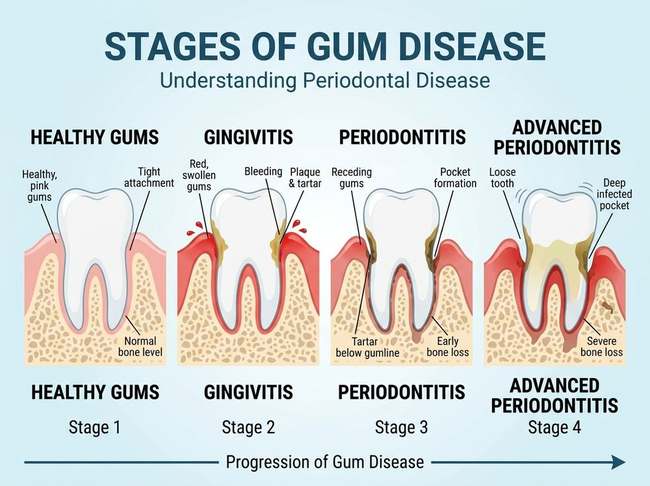
Gingivitis is the early stage. Gums that are red, puffy, or bleed when you brush or floss are the classic signs — irritation from plaque buildup along the gumline, with no damage yet to the bone or ligaments holding your teeth in place. This is the stage that’s genuinely, fully reversible with a professional cleaning and better home care. Nothing has been lost yet; it’s inflammation, not damage.
Periodontitis is what gingivitis turns into if it isn’t addressed. Plaque and bacteria work their way below the gumline, forming pockets that a toothbrush can’t reach. Over time this starts to break down the bone and connective tissue anchoring your teeth — which shows up as receding gums, persistent bad breath, gums that look pulled back from the teeth, or teeth that feel a little loose. Once bone and tissue are lost, that specific damage doesn’t grow back on its own. Periodontitis is managed, not reversed — but “managed” still means stopping it in its tracks and protecting everything you haven’t lost yet.
The honest short answer: yes, gum disease can be reversed — if it’s caught while it’s still gingivitis. That’s the whole reason routine cleanings and checkups matter even when nothing feels wrong.
It’s not just about your gums
Gum disease is worth taking seriously for reasons beyond the mouth. A 2023 meta-analysis pooling data from 26 studies and over 2.7 million people found that periodontal disease is associated with a meaningfully higher risk of cardiovascular disease — in both men and women, at similar rates. The likely link is inflammation: the same bacteria and ongoing inflammatory response driving gum disease appear to contribute to inflammation elsewhere in the body, including in blood vessels.
To be clear, this is an association, not proof that gum disease directly causes heart disease — but it’s a strong enough pattern that treating gum disease is increasingly viewed as part of protecting your overall health, not just your smile. It’s one more reason a “it’s just a little bleeding” gum issue is worth an actual look rather than a shrug.
What happens if you wait
Gingivitis doesn’t hurt, which is exactly what makes it easy to ignore. But left alone, the bacteria causing it don’t stay put — they move below the gumline, out of reach of normal brushing and flossing, and start the slow process of breaking down the bone and tissue that hold your teeth in place. That process doesn’t announce itself with pain until it’s fairly advanced. By the time you notice loose teeth, receding gums, or a bad taste that won’t go away, some of that damage has already happened and can’t be undone — only stopped from progressing further.
The good news is that this process is slow and very treatable at every stage. The earlier we catch it, the simpler and less invasive the treatment.
How we treat it, stage by stage
Gingivitis: catching it while it’s still reversible
If you’re caught at the gingivitis stage, treatment is refreshingly straightforward: a thorough professional cleaning to remove the plaque and tartar buildup causing the irritation, paired with better daily brushing and flossing habits at home. Most patients see their gums calm down — less redness, less bleeding — within a couple of weeks of a cleaning and consistent home care. No drilling, no numbing, no downtime.
Periodontitis: managing it once it’s progressed
Once bacteria have moved below the gumline, a regular cleaning isn’t enough to reach them. We use scaling and root planing — a deep cleaning that removes plaque and tartar from below the gumline and smooths the tooth root so gum tissue has an easier time reattaching. This is typically done in one or two visits, with local anesthetic to keep it comfortable. After that, we move you to more frequent maintenance cleanings (rather than the standard twice-a-year schedule) to keep the disease from advancing, along with home-care guidance tailored to what we’re seeing.
For more advanced cases where bone loss is significant, we may recommend seeing a periodontist for specialized treatment beyond what a general dental office typically provides — we’ll tell you plainly if that’s the right next step for you rather than trying to handle everything in-house. Full detail on what an exam and treatment plan look like is on our Periodontal (Gum) Treatment page.
The one thing that makes it worse
Skipping cleanings, or waiting to get bleeding gums checked out “until it’s worse,” is the single biggest factor that turns a simple, reversible problem into a permanent one. Gum disease doesn’t reverse itself, and it doesn’t stay at one stage indefinitely — it’s a one-way slide unless something interrupts it. The earlier that happens, the less there is to manage later.
Common questions
Can gum disease really be reversed?
Yes, if it’s caught at the gingivitis stage — the earliest phase, before any bone or tissue has been lost. A professional cleaning and consistent home care can bring your gums back to healthy. Once it progresses to periodontitis, existing bone and tissue loss can’t be reversed, but the disease itself can absolutely be stopped and managed.
What’s the actual difference between gingivitis and periodontitis?
Gingivitis is inflammation only — red, swollen, or bleeding gums with no damage yet to the bone or ligaments underneath. Periodontitis is what happens if that inflammation isn’t treated: the infection moves below the gumline and starts breaking down the structures that hold your teeth in place.
Does gum disease actually affect more than my mouth?
There’s a well-documented association between gum disease and cardiovascular disease risk, likely related to the inflammation gum disease causes throughout the body. It’s not a guarantee of heart problems, but it’s one more good reason to treat gum disease seriously rather than letting it sit.
Is scaling and root planing painful?
It’s done with local anesthetic, so the procedure itself shouldn’t hurt. Some soreness or sensitivity for a day or two afterward is normal, similar to how a deep cleaning of any kind can leave gums a little tender.
How often do I need cleanings if I’ve had gum disease?
More often than the standard twice-a-year schedule — typically every three to four months once periodontitis has been treated, so we can keep an eye on things and catch any recurrence early. We’ll set the right interval for you based on what we see.
What if my gum disease is more advanced than a regular cleaning can handle?
We’ll tell you directly. Early and moderate cases are treated in-house with scaling and root planing and a maintenance schedule; for more advanced bone loss, we may recommend a periodontist for specialized care, and we’ll help coordinate that referral rather than leaving you to figure it out.
Come see us
Bleeding gums are easy to dismiss, but they’re also one of the clearest early warning signs your mouth gives you — and one of the easiest problems to fully resolve if you catch it in time. If it’s been a while since your last cleaning, or something about your gums has felt off, that’s worth a look.
Island Dentists treats gum disease at every stage, from a straightforward cleaning to scaling and root planing for more advanced cases, right here in Palatka. We accept most dental insurance, including Medicare Advantage plans, and offer financing through CareCredit and Cherry for anything insurance doesn’t cover.
We’re open Monday through Friday, 9:00 AM to 4:00 PM, with alternating Saturday hours from 8:00 AM to 1:00 PM. Call us at (386) 385-3700 to schedule a cleaning or exam.
New patients are always welcome.